





Reslating an ancient water mill
The need for major repairs to a historic mill provided a rare opportunity to record, study and repair early vernacular roofs, using authentic materials and traditional techniques.
All photos by Terry Hughes, S&SC, unless otherwise credited

|
| The mill in 2022 (Photos: Andy Marshall, Architectural Photography) |
Contents |
Introduction
Melin Daron is an ancient water mill in Aberdaron village on the Llŷn peninsula in Gwynedd, north Wales. The buildings were covered in a variety of slate roofs as the mill grew over the centuries, but by 2022 they all needed substantial repairs. This provided a rare opportunity to record, study and repair early vernacular roofs, using authentic materials and traditional techniques. The re-roofing was mostly completed in 2024, with the final two roofs due to be conserved in 2025.
The mill is the most complete survival in the region, with the majority of the machinery still in its original position. It is believed to have existed from at least the 13th century, when the village was the embarcation point for pilgrims visiting Bardsey Island. Three pilgrimages to Bardsey, acts of Christian devotion, were the equivalent of one to Jerusalem.
An archaeological investigation suggested that the mill was built in three phases. In 2022 a preliminary survey report by Slate and Stone Consultants (S&SC) concluded that the roof had historical significance and should be conserved as found (rather than a notional restoration) to illustrate the evolution of slate quarrying, roof slates and slating techniques from vernacular to modern. This was agreed by the charity Melin Daron Cyf, Cadw and Gwynedd Council’s conservation team.
A conservation slating and tiling company, W J Conservation (WJC), led by former SPAB fellow Richard Jordan, was appointed to carry out the work, and a provisional reslating plan was prepared with S&SC. [1] This would be revised in detail during stripping. The objectives of the detailed plan were to reinstate the slating, applying the existing vernacular and the more modern slating techniques [2] ; to reuse as many as possible of the existing slates; and, where necessary, to improve the roof’s resistance to wind and rain to combat climate change without unacceptably affecting its appearance. This would follow the principles of Historic England’s upcoming Code of Practice. [3]

|
| The roof in 2022. The red areas were random slates, and the black were tally slates (slates of a uniform, single size). Before slating commenced, Building 7, a recent store shed, collapsed and was abandoned. |
The oldest part of the remaining slating was on Phase 1, Slope 2 and the valley. It consisted of small, thick, coarsely textured slates peghung on riven laths and torched in 1:1 air lime: sharp sand mortar. Originally all of Phase 1 would have been similarly slated. These slates are typical of the production in small shallow quarries operated by a few workers and with a small output. They were produced in random sizes and sold by weight, sufficient to cover a given roof area. Typically in Lleŷn, they would include a few courses of 16- or 14-inch-long slates, with the rest of the roof 12- and 10-inch, all with a narrow range of widths.
Slopes 3, 4 and 6 illustrated how slates changed as the quarries became larger and deeper. They also showed how the quality of slaty cleavage improved, how they produced thinner, slightly smoother and larger slates, but still with a modest output and so still sold in random sizes. The slates were still peg-hung on riven laths and torched.
By the 19th century, quarries and mines had become very much larger and deeper, and production had expanded to the extent that slates could be sold in single sizes (tally slates of a uniform, single size, sold by count rather than as random slates sold by weight). These large, thin slates are more susceptible to wind uplift than small, thick slates. This resulted in a change from peg hanging or top nailing to the more wind-resistant centre-nailing system. This type of slate had been used to reslate Slopes 5 and 9–11, double lapped and centre nailed.

|

|

|
| The earliest slating on Slope 2 and the valley and reslating on Slope 1. By this time the early slating had deteriorated and been ‘repaired’ with cement mortar. | Slope 3 had been raised and reslated with slightly thinner and larger slates from a larger and deeper quarry, but they were still random sized. | Slopes 5B and 6. Random slating on Slope 6, as on Slopes 3 and 4. The formerly random slating on Slope 5 had been changed to thin large slates, centre nailed. |
Slate supply
As many slates as possible were reused. Where new tally slates were needed to make up a shortfall, they were obtained from Welsh Slate Ltd in appropriate colours: heather blue from Penrhyn, and grey from Cwt y Bugail quarries. Random slates were made on site by WJC using block from the same quarries. When the existing tally slates on Slope 1 were originally made, the width variation was greater than the standardised modern range of widths, ± 5 mm. To replicate this, the new tally slates were trimmed on site to a wider width variation. On the roof this can be seen in how the perpendicular lines wander slightly.
On Slope 10, slates from Slopes 1, 8 and 10 were reused, centre nailed at an adequate head lap. This involved mixing the two colours, but this was the least visible slope.

|

|

|
| A&B random slates are no longer available, so block was purchased from the same quarries and handmade on site by WJC. | On Slope 1, new slates were redressed on site to various widths to replicate the early modern slates which had large dimensional variation. This shows how the perpendicular joints wander slightly. |
Driving rain

|

|
| Slope 3. New slates laid at three-and-a-half pin | Slating in thirds Slope 5B. |
Three slating systems had been used to resist driving rain: gauged at three-and-a-half pin [4] on the oldest Slopes 2–4 and 6, which is triple lapping and gauged in thirds on Slopes 1 and 8. On Slopes 5 and 9–11 double lapping to a specified head lap had been used, which is how slates are normally fixed for new roofs today.
Thirds slating is a method of gauging the roof (setting out the laths) at one third of the slate length and hence a large head lap. Three and a half pin gauges the laths at two sevenths of the length by dividing by 3.5, providing an even larger head lap and an extra layer of slates. This is essential to prevent leaks with very narrow slates with small side laps. Besides preventing leaks, these systems help the slater, who has to select and place each slate using experience and judgement, to have adequate side lap over the slates below. Because side laps can be smaller, the decisions are easier, and the work faster and cheaper. In the centre-nailed, double-lap system, the head lap is specified in relation to the roof pitch, driving rain exposure and slate size [5], and hence the batten gauge is the slate length minus the head lap and divided by two.
A further technique, tilting the slates, had been used to prevent leaks by directing water away from vulnerable areas. This is most relevant in the Welsh valley which was lined with slates rather than lead, which would have been unavailable or too costly. The valley slates are tilted up at each side by the valley board, turning water towards the centre line. On either side the slates overlap on to the valley slates, directing water away from the junction. The other valleys were all lead lined.
Another tilting technique, doubling — laying two slates on top of each other — was applied to lift the slating to ensure that overlying slates sit tightly together, or to redirect water flow.
On the existing roof, the masonry mortar had been washed out at the gutterless eaves, especially below the valleys. Here the overhang was extended in order to throw water away from the walls. Also, close to the foot of the Welsh valley a doubled slate was laid to tilt the slating, and turn water away from the verge and into the valley. At the other verges the slating was tilted by doubling or lifting it on counter laths or battens.

|

|

|
| Slope 11. Slates laid at a specified head lap | The slates in a Welsh valley are tilted up at the sides by the valley boards, directing water to the centre. | Slating was raised on counter battens at the verges to direct water on to the roof slope. |

|

|
| Slope 2. Close to the foot of the Welsh valley a doubled slate tilted the slating to turn water away from the verge. | Slope 2. Slating tilted up by the valley slates |

|

|
| Slope 5B. The original random slating near the eaves was renewed with similarly thick slates. These tilted the tally slating above to ensure that the slates rested on the head battens. | In anticipation of worsening storms, the resistance of head-pegged verge slates was improved with tee nails. These fix the slates at a lower position into the counter batten. |

|

|
| All the slating except Slopes 10 and 11 was torched with well-haired 1:1 air lime:sharp sand mortar, further stabilising the slating and preventing condensation drips on to the mill machinery. |
Wind resistance
The two early systems on Slopes 2–4 and 6 and the reslated Slopes 1 and 8, were renewed by pegging to riven laths and head bedded in 1:1 air lime: sharp sand mortar. This supports the slates’ heads, locking them together with surrounding slates, so they share fluctuating wind loads as they ripple across the roofs.
At the eaves where there were no wall plates, a doubled layer of mortar bedded under eaves slate, was reinstated. This levelled the wall head and provided tilt, ensuring that the overlying slates’ heads were on the battens. Similarly, on Slope 5, when the slates had been replaced with tally slates, they were laid on to the original random slates at the eaves. Replicating this with similarly thick random slates provided tilt to the tally slates.
At the verges, the overhang was reduced slightly to reduce wind exposure. To improve the resistance, tee nails were used at every third or fourth course, fixed into the counter laths or battens.
All the slating, except on Slopes 10 and 11, was torched with well-haired 1:1 air lime: sharp sand mortar, further stabilising the slating, and having an additional purpose, to absorb condensation. Drips of condensation from cold slates would wet the flour, clogging the mill stones and machinery. Slopes 10 and 11 were not torched originally or in the reslating, to allow moisture from the corn drying to ventilate through the slates. Originally there was also a vent at the ridge, yet to be reinstalled, for the same purpose.
Completion
Work started in September 2024 and was completed by Christmas, with the original vernacular and modern techniques applied throughout and using authentic slate types on each slope. The techniques’ effectiveness was demonstrated during Storm Darragh when only Slope 1 had been slated – the opposite slope was effectively open to the 96mph wind measured in Aberdaron. Not a single slate was disturbed, although other roofs nearby were damaged. Later the finished slating was completely unaffected by the severe Storm Éowyn in January.
Further reading
- English Heritage (2005) Stone Slate Roofing Technical Advice Note, (revision including metamorphic slates in preparation)
- Historic England (2013) Practical Building Conservation: roofing
- Emerton, Gerald (2017) The Pattern of Traditional Roofing
- Hughes, Terry (2023) ‘Surveying vernacular roofs’, Context 178, December
- Historic England (in preparation) Code of Practice for Slate and Stone Roof Repair and Conservation
References
- [1] Architect Donald Insall Associates, Conwy; main contractor Grosvenor Construction
- [2] Vernacular and modern slating techniques are explained and illustrated on the S&SC Historic Roofs website, https://bit.ly/4eorfiI
- [3] Conservation and Repair of Slate and Stone Slate Roofs (in preparation)
- [4] ‘Three-and-a-half pin’ is the name used in Cornwall. Other local names are not known.
- [5] See BS5534 Code of practice for slating and tiling for pitched roofs and vertical cladding.
Images
Slope 5B. The original random slating near the eaves was renewed with similarly thick slates. These tilted the tally slating above to ensure that the slates rested on the head battens.
The slates in a Welsh valley are tilted up at the sides by the valley boards, directing water to the centre.
The original random slating near the eaves was renewed with similarly thick slates. These tilted the tally slating above to ensure that the slates rested on the head battens.
In anticipation of worsening storms, the resistance of head-pegged verge slates was improved with tee nails. These fix the slates at a lower position into the counter batten.
All the slating except Slopes 10 and 11 was torched with well-haired 1:1 air lime:sharp sand mortar, further stabilising the slating and preventing condensation drips on to the mill machinery.
This article originally appeared in the Institute of Historic Building Conservation’s (IHBC’s) Context 185, published in September 2025. It was written by Terry Hughes, an independent and Historic England slate and stone roofing consultant, and the UK slate industry’s representative on UK and European technical committees. He is grateful for contributions to this paper from Chris Wood and Richard Jordan, and to Welsh Slate Ltd for support in obtaining special slates.
--Institute of Historic Building Conservation
Related articles on Designing Buildings Conservation.
IHBC NewsBlog
IHBC sponsors Gardens Trust event 23-4 Sept 2026
.jpeg)
'Learning from the Past, Shaping the Future’ takes place in Milton Keynes
Renovations to Frank Lloyd Wright's Fallingwater complete
.jpg)
World Heritage Preserved project opens house for tours again
Shakespeare Birthplace Trust places Hall's Croft on HAR Register
Stratford-upon-Avon home of Shakespeare's daughter is 'At Risk'
Lady Grange’s House repaired on St Kilda
.jpg)
National Trust for Scotland repairs stone cleit with link to famous island resident
Griff Rhys Jones on BBC Radio 4 Today programme
,_Green_Lane,_Derby.jpg)
The Victorian Society’s President unveiled its latest Top Ten Endangered Buildings 2026.
Need a MATE? Book your place now.

IHBC offers free webinars on applying for IHBC accreditation (Full & Associate).
UK Stained Glass Repository finds windows new homes

How are stained glass windows are rescued, stored and repurposed?
APPGEBE report sets high aims for quality
'Government must not sacrifice quality in drive to build 1.5m homes'
New measures protect Historic Shipwrecks from heritage crime

Underwater cultural heritage benefits from new HE guidance
How could the City of London skyline look in 6 years' time?

Visualisation shows approved planning applications as completed buildings
National Trust for Scotland calls for VAT cuts

Heritage neglect is encouraged by current policies
IHBC's 'Context' Issue 186 features Industrial Heritage

IHBC's members' journal reports on the challenges of conserving infrastructure
Book now for IHBC Annual School 2026

IHBC Annual School is taking place 18-20 June 2026 in Newcastle
RICHeS Research Infrastructure offers ‘Full Access Fund Call’
RICHeS offers a ‘Help’ webinar on 11 March
Latest IHBC Issue of Context features Roofing
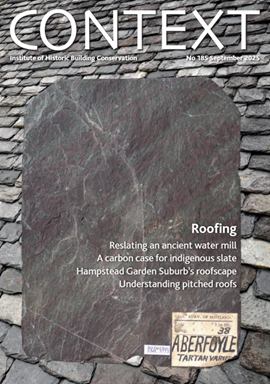
Articles range from slate to pitched roofs, and carbon impact to solar generation to roofscapes
Three reasons not to demolish Edinburgh’s Argyle House

Should 'Edinburgh's ugliest building' be saved?
IHBC’s 2025 Parliamentary Briefing...from Crafts in Crisis to Rubbish Retrofit

IHBC launches research-led ‘5 Commitments to Help Heritage Skills in Conservation’
How RDSAP 10.2 impacts EPC assessments in traditional buildings

Energy performance certificates (EPCs) tell us how energy efficient our buildings are, but the way these certificates are generated has changed.